Hard Hats and Soft Values: Why Organisational Culture Makes or Breaks a Construction Site
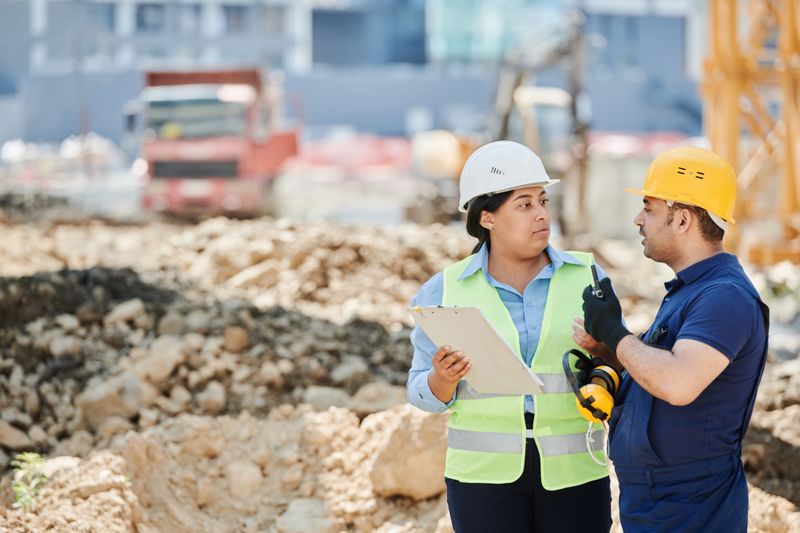
Image 1 — Two construction workers discussing on site: the culture of a construction site is not just about procedures and paperwork — it is about how people actually treat each other every single day.
Introduction
Walk onto two construction sites in Sri Lanka and you can feel the difference between them. One has workers who greet each other and follow safety procedures, with supervisors who lead by example rather than just dictate. On the other, corners are cut, safety gear is not worn and the atmosphere is not one to be proud of. From the outside the buildings may look the same — but the culture within is worlds apart.
Organisational culture is not just a fuzzy concept. On a construction site, it determines whether your workforce is disengaged or fully committed. In Sri Lanka's construction industry, culture is perhaps the most powerful — and least considered — force within the workplace.
What Is Organisational Culture?
Armstrong (2020) defines organisational culture as the values, norms, beliefs and assumptions that guide how people behave within an organisation. It is not what is written in the company handbook — it is what actually happens when nobody is watching.
Schein (1985) identified three levels of organisational culture. The first level — Artefacts — is what you can see and hear on site: safety signage, PPE and the way supervisors interact with workers. The second level — Espoused Values — refers to what the organisation claims to believe: safety first, people matter, quality above all. The third level — Basic Assumptions — represents the deeply held beliefs that actually drive behaviour: deadlines matter more than safety, workers are replaceable, shortcuts save time. In Sri Lanka's construction sector, the gap between espoused values and basic assumptions is often enormous.
Figure 1 — Schein's Three Levels of Organisational Culture (1985) Applied to Sri Lanka Construction
| Level | What It Means | Ideal Site | Reality on Many Sites |
|---|---|---|---|
| Artefacts | Visible signs and symbols | PPE worn, safety signs visible, clean site | PPE ignored, signs present but unread |
| Espoused Values | What organisation says it believes | Safety first, people matter | Safety first — but deadline comes first |
| Basic Assumptions | Deep beliefs driving behaviour | Workers are assets — invest in them | Workers are replaceable — shortcuts save time |
Source: Adapted from Schein (1985)
Video 1 — Organisational Culture Explained
Source: YouTube
The Construction Culture Problem
Handy (1993) identified four types of organisational culture — Power, Role, Task and Person. Construction sites in Sri Lanka generally operate within a Power Culture, where decisions flow from the top, the site manager has the final say and worker input is minimal. This can work effectively when leadership is strong and values are sound. But when the leader prioritises production over people, that mindset permeates the entire site culture.
Figure 2 — Handy's Four Types of Organisational Culture (1993) Applied to Sri Lanka Construction
| Culture Type | Key Feature | Construction Example | Risk |
|---|---|---|---|
| Power Culture | Decisions from the top | Site manager controls everything — most common in Sri Lanka | If leader has poor values — whole site suffers |
| Role Culture | Rules and procedures | Large multinational contractors with formal systems | Can become rigid and slow to adapt |
| Task Culture | Focus on getting job done | Project teams working collaboratively | Can ignore long term people development |
| Person Culture | Individual expertise valued | Specialist subcontractors and consultants | Difficult to manage as a unified team |
Source: Adapted from Handy (1993)
Martínez-Córdoba et al. (2023) found in their study of construction firms that organisational culture directly influences both safety performance and overall firm performance. Firms with strong collaborative cultures consistently outperformed those with hierarchical, command-driven structures — not just in safety, but in productivity and worker retention too.
The Reality on Site
In practice, organisational culture on Sri Lankan construction sites is inconsistent. On large multinational projects, formal cultural frameworks exist — safety culture is enforced, workers are trained and values are communicated clearly. On smaller domestic projects, culture tends to reflect the individual site manager's personality. Where the manager values safety, the site culture follows. Where the manager focuses only on schedule, a culture of cutting corners emerges.
This is the fundamental problem. Organisational culture cannot be left to depend on the personality of one individual. It must be embedded into systems, processes and leadership behaviour at every level of the organisation.
The Sri Lanka Context
Construction sites in Sri Lanka bring together workers from diverse cultural backgrounds — local Sri Lankans, South Asian migrant workers and international management teams. Hofstede (1980) identified that different national cultures adopt fundamentally different attitudes toward authority, hierarchy and workplace norms. When these cultures meet on a construction site without a strong shared organisational culture to unite them, misunderstanding and conflict are inevitable.
The absence of a strong safety culture is particularly costly. Sites where safety is genuinely valued have fewer accidents, lower absenteeism and higher productivity. Sites that treat safety as a paperwork exercise consistently produce the opposite results.
A Fair Criticism
Building a strong organisational culture takes time and consistent leadership commitment — both of which are scarce on project-based construction sites where teams change regularly. Armstrong (2020) acknowledges that culture change is one of the most difficult challenges in HRM and cannot be imposed overnight.
But this difficulty is not an excuse for inaction. Small consistent steps — a supervisor who always wears PPE, a morning briefing that genuinely values worker input, a system that recognises safe behaviour rather than just fast output — build culture over time.
Conclusion
The most important thing on a construction site is not the crane, the concrete or the contract. It is the culture.
Improving Sri Lanka's construction industry does not only mean changing procedures. It means changing the values, behaviours and assumptions that determine how work actually gets done on site every single day. That is the work of HRM. And it starts at the top.
References
Armstrong, M. (2020) Armstrong's Handbook of Human Resource Management Practice. 15th edn. London: Kogan Page.
Handy, C. (1993) Understanding Organizations. 4th edn. London: Penguin Books.
Hofstede, G. (1980) Culture's Consequences: International Differences in Work-Related Values. Beverly Hills: Sage.
Martínez-Córdoba, P.J., Benito, B. and García-Sánchez, I.M. (2023) 'Influence of organizational culture on construction firms' performance', Buildings, 13(2), p. 308.
Schein, E.H. (1985) Organizational Culture and Leadership. San Francisco: Jossey-Bass.


Really insightful post Sanjeewa, I like how you’ve highlighted the gap between espoused values and actual site behavior, two vital parts of organizational culture, it makes the importance of culture very clear. The application of the Hofstede's ideology really emphasizes on the practical issues employees face and how diverse attitudes could lead to conflict. The comparison between multinational projects and smaller domestic sites was especially eye opening, and the point that culture can’t just depend on one manager really stood out.
ReplyDeleteWhat practical steps do you think smaller construction firms in Sri Lanka could take to build a stronger safety culture without the resources that large multinational projects have?
Thank you Shewan! Great question. For smaller firms with limited resources, the most practical starting point is leadership behaviour — a site manager who consistently wears PPE, listens to workers and addresses safety concerns immediately sends a powerful cultural message without any financial cost. Simple daily briefings where workers can raise concerns also build culture over time."
DeleteYour analysis of Handy’s Power Culture to the Sri Lankan construction industry is a great catch. Since the site atmosphere often comes down to the individual site manager's personality, I'm interested in what you think the biggest obstacle to a "Task Culture" is. Do you believe the move toward collaborative problem-solving is held back more by supervisors lacking formal leadership training, or by a workforce that has been socially conditioned to expect and follow a strict top-down hierarchy?
ReplyDeleteThank you Harshani! Both factors play a role — but in my experience the bigger barrier is the workforce being conditioned to expect top-down authority. Even when supervisors want to be collaborative, workers sometimes feel uncomfortable challenging or contributing ideas. Changing this requires consistent encouragement from management over time.
DeleteWhile construction sites are often associated with safety equipment and technical standards, organisational culture plays an equally critical role in shaping performance and safety outcomes. A strong culture built on trust, communication, and mutual respect can significantly reduce accidents, improve teamwork, and boost productivity
ReplyDeleteThank you Janith! Absolutely — technical standards alone cannot create a safe site. When workers trust their supervisors and feel their wellbeing genuinely matters, they are far more likely to follow safety procedures voluntarily rather than just when someone is watching.
DeleteInsightful article! It clearly shows that combining “hard” safety practices with “soft” values like communication and culture is key to improving workplace outcomes. Do you think organisations that focus more on these soft values will see better long-term performance and safety results?
ReplyDeleteThank you Ashan! Yes — organisations that invest in soft values consistently show better long-term results. Safety culture built on genuine values rather than compliance reduces accidents, lowers absenteeism and improves retention — all of which directly impact project profitability.
DeleteVery true, real workplace culture is shown by how people behave daily, not by what is written in company policies. In many real construction sites, workers follow the attitude of their supervisors, whether good or bad. How can a company expect discipline and safety when leaders themselves fail to set the right example?
ReplyDeleteThank you for this. The uncomfortable truth is that discipline and safety cannot be demanded from below when they are not demonstrated from above. Workers are rational — they follow what is actually rewarded and modelled, not what is written on a notice board. Changing that starts with holding supervisors accountable for their behaviour, not just their output targets.
DeleteThis is an insightful discussion of how deeply organisational culture influences safety and performance in construction. The emphasis on leadership-driven culture in project-based environments is particularly convincing.
ReplyDeleteAgreed — and the project-based nature is precisely what makes it so difficult. When teams dissolve at the end of every project, cultural norms have to be rebuilt from scratch each time. That is why embedding culture into systems and selection criteria — rather than relying on individual leaders to carry it — is the only sustainable approach for an industry that is structurally fragmented by design
Delete